
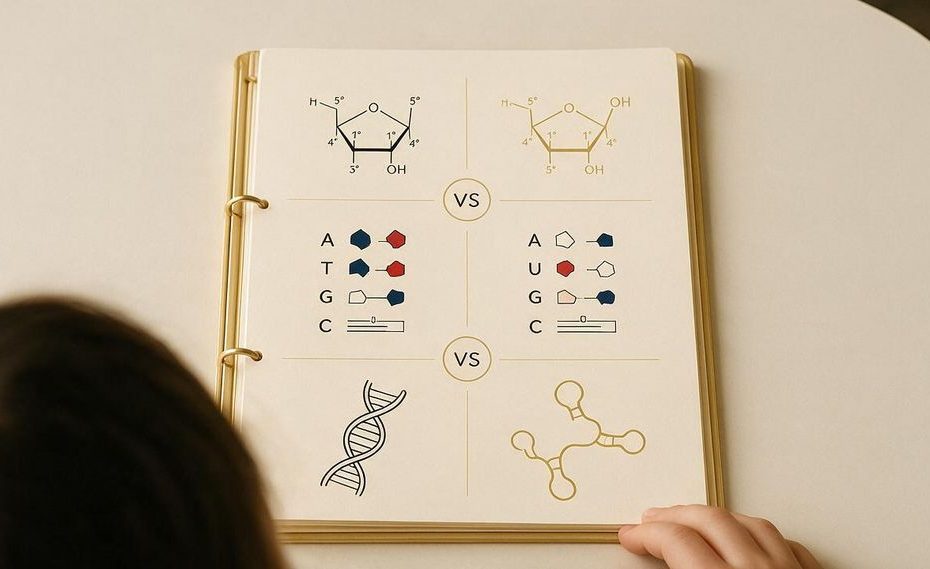
The main DNA and RNA differences involve their sugar, shape, chemical bases, jobs, and usual locations inside a cell. DNA serves as stable, long-term storage for genetic information, and RNA helps cells read and use that information.
Think of DNA as a master cookbook protected in a library. RNA is more like a copied recipe carried to the kitchen, where the instructions can be put to work. Understanding that relationship helps you compare these molecules without getting buried in chemistry terms.
What Are DNA and RNA? A Quick Primer
Deoxyribonucleic acid (DNA) and ribonucleic acid (RNA) are nucleic acids, a category of molecules that cells use to store, carry, and read biological instructions. Each one is built from smaller units called nucleotides. A nucleotide contains a sugar, a phosphate group, and a nitrogenous base. The sugar and phosphate units connect to form a sugar-phosphate backbone, and the bases carry coded information.
DNA and RNA share several features, so their diagrams can look confusing at first. They use similar building blocks and share three bases: adenine, cytosine, and guanine. Their differences allow them to handle separate parts of the same process. DNA protects the genetic code, and RNA helps turn selected instructions into working products.
Difference 1: The Sugar, Deoxyribose vs. Ribose
DNA contains a sugar called deoxyribose, and RNA contains ribose. The names sound similar because the sugars have closely related structures. Ribose has an oxygen-containing group on its 2′ carbon that deoxyribose lacks. A useful memory hook is “deoxy means missing an oxygen.”
That small chemical difference changes how the molecules behave. Ribose makes RNA more chemically reactive and less stable, which fits many of RNA’s temporary working roles. Deoxyribose helps DNA remain stable enough to preserve genetic information over long periods. In the cookbook analogy, DNA is printed on material designed for storage, and RNA is printed on a working sheet meant for regular use.
You don’t need to memorize a detailed chemical diagram to explain this difference. Focus on the missing oxygen and what it means for stability. Deoxyribose supports DNA’s long-term storage role, and ribose gives RNA chemistry suited to shorter-term cellular tasks. That single distinction often makes the sugar names easier to remember.
Difference 2: The Shape, Double-Stranded vs. Single-Stranded
DNA is usually double-stranded, with two nucleotide chains joined in a double helix. Bases on one strand pair with bases on the other through hydrogen bonds. Adenine pairs with thymine, and cytosine pairs with guanine. This matching system gives DNA a reliable way to preserve and copy genetic information.
RNA is usually single-stranded, but “single-stranded” doesn’t mean it always forms a straight line. An RNA strand can bend and fold, allowing bases in different parts of the same molecule to pair. These folds can create short double-stranded regions and complex three-dimensional shapes. Some RNA also pairs with separate RNA strands.
The cookbook comparison makes the basic shape difference easier to explain. DNA resembles a protected master volume with matching information that supports accurate copying. RNA resembles one usable recipe sheet that can fold into the shape needed for a particular task. The accurate statement is that RNA is usually single-stranded, not that it must always remain straight or unpaired.
Difference 3: The Bases, Thymine vs. Uracil
DNA uses four nitrogenous bases: adenine (A), thymine (T), cytosine (C), and guanine (G). RNA also uses four, but it replaces thymine with uracil (U). Its alphabet is adenine, uracil, cytosine, and guanine. The easiest memory rule is simple: T belongs to DNA, and U belongs to RNA.
During DNA base pairing, adenine matches with thymine, and cytosine matches with guanine. When an RNA copy is produced from a DNA template, RNA uses uracil across from DNA’s adenine. Cytosine still pairs with guanine. These matching rules allow a cell to copy a selected genetic message accurately.
Return to the cookbook analogy when the letters become confusing. The protected cookbook uses T in its written code, and the copied recipe uses U in the matching position. Most of the alphabet stays the same. Only one letter changes between the two molecules.
Difference 4: The Job, Storing Genetic Information vs. Making Proteins
DNA’s main job is to store and transmit genetic information. Genes are sections of DNA containing instructions that cells can use. The DNA in a human haploid genome contains about three billion base pairs, packaged into chromosomes. This vast store of information acts like the complete cookbook kept for long-term reference.
RNA handles several working roles connected to gene expression and protein synthesis. Messenger RNA (mRNA) carries a copied genetic message from DNA. Transfer RNA (tRNA) helps match that message with the amino acids used to build a protein. Ribosomal RNA (rRNA) forms a major part of ribosomes, the cellular structures where proteins are assembled.
Cells use two linked processes to move from stored information to a protein. During transcription, a section of DNA serves as the template for an RNA molecule. During translation, a ribosome reads messenger RNA and uses its sequence to guide protein assembly. DNA keeps the master instructions, and RNA carries out selected instructions when the cell needs them.
Difference 5: Location and Lifespan, Nucleus vs. Cell
Most DNA in a human cell is stored in the nucleus, where chromosomes are kept. Mitochondria also contain a small amount of DNA. Keeping most DNA in the nucleus helps maintain an organized, protected store of genetic information. It is similar to leaving the master cookbook in the library instead of carrying it into the kitchen.
RNA is synthesized from DNA in the nucleus, but many RNA molecules work elsewhere. Messenger RNA can move into the cytoplasm, where ribosomes read it. Ribosomal RNA works as part of ribosomes, and transfer RNA brings amino acids to those structures. RNA can therefore operate throughout several parts of the cell.
The molecules also tend to differ in length and lifespan. Chromosomal DNA molecules are very long and built for continued storage. RNA molecules are usually shorter and often remain active for a more limited period. A cell can produce, use, regulate, and break down RNA as its needs change.
DNA and RNA Differences at a Glance
The five differences become easier to remember when you connect each physical feature with a practical job. DNA’s deoxyribose sugar, paired strands, and stable structure fit long-term information storage. RNA’s ribose sugar and flexible single-stranded form support active cellular tasks. Their chemical designs match the work they perform.
The table below gives you a quick study guide. Read across each row rather than memorizing two separate lists. Linking the features side by side reduces confusion between deoxyribose and ribose, or thymine and uracil. It also keeps simplified rules from becoming misleading absolutes.
DNA and RNA Differences: Simple Comparison Table
|
Feature |
DNA |
RNA
|
|
Sugar |
Deoxyribose |
Ribose |
|
Usual shape |
Double-stranded double helix |
Single-stranded and able to fold |
|
Unique base |
Thymine |
Uracil |
|
Main job |
Stores and transmits genetic information |
Carries and uses genetic instructions |
|
Usual location |
Mainly the nucleus, with some DNA in mitochondria |
Made in the nucleus and active across the cell |
|
Typical stability |
More chemically stable |
More reactive and less stable |
|
Typical length |
Very long chromosome-sized molecules |
Usually shorter working molecules |
Common Misunderstandings About DNA and RNA
One common mistake is saying that RNA is always a straight, single strand. RNA is usually single-stranded, yet it often folds back on itself and forms paired regions. Some RNA molecules can also pair with other RNA strands. “Usually single-stranded” is more accurate than “always single-stranded.”
Another mistake is saying that DNA never leaves the nucleus or that all RNA stays in the cytoplasm. Most cellular DNA is in the nucleus, but mitochondria contain DNA too. RNA is produced in the nucleus, and many RNA molecules later work in the cytoplasm or at ribosomes. Location describes where these molecules are commonly found and used, not an unbreakable rule.
You may also hear that RNA’s only job is carrying messages. Messenger RNA does carry genetic instructions, but transfer RNA and ribosomal RNA have different jobs in protein synthesis. Other RNA molecules help control gene activity or perform specialized cellular work. RNA is a group of working molecules rather than one single type of copy.
How Do DNA and RNA Work Together?
DNA and RNA connect stored genetic information to the proteins a cell builds. A cell begins by using part of a DNA strand as a template during transcription. The resulting messenger RNA contains a portable copy of that selected instruction. The original DNA remains stored as the master record.
The messenger RNA then travels to a ribosome, where translation occurs. The ribosome reads the message, and transfer RNA helps place amino acids in the required order. Ribosomal RNA supports the structure and activity of the ribosome. The finished chain of amino acids folds into a protein that can perform a cellular job.
The cookbook analogy follows this sequence closely. DNA is the cookbook in the library, transcription is the copying process, and messenger RNA is the recipe sent to the kitchen. The ribosome acts as the kitchen workspace, with transfer RNA delivering the ingredients. This comparison explains why cells need a protected information store and separate working molecules.
Easy Memory Tricks for Students and Parents
Connect each name with one clear clue. DNA has deoxyribose and thymine, and RNA has ribose and uracil. Remember “deoxy means missing an oxygen” for the sugar difference. Remember “U goes with RNA” for the base difference.
Use the phrases “master copy” and “working copy” to separate their jobs. The master copy is stable, protected, and designed for long-term storage. The working copy is shorter, flexible, and used where the instructions are needed. These phrases are simplified, but they preserve the main biological distinction.
You can also match shape with purpose. DNA’s paired strands suit the protected master record, and RNA’s usual single-stranded form can fold into shapes suited to different tasks. Avoid treating the memory trick as a rule without exceptions. A good explanation stays simple and still includes words like “usually,” “mainly,” and “typically” where accuracy requires them.
What Are the Key Differences Between DNA and RNA?
- DNA: double strand; RNA: usually single strand
- DNA: deoxyribose; RNA: ribose
- DNA: thymine; RNA: uracil
- DNA: stores genes; RNA: helps make proteins
- DNA: mainly in nucleus; RNA: works across cell
Keep the Master Copy and Working Copy Straight
The easiest way to remember the DNA and RNA differences is to connect structure with purpose. DNA uses deoxyribose, usually forms a double helix, contains thymine, and serves as the cell’s stable store of genetic information. RNA uses ribose, is usually single-stranded, contains uracil, and performs working roles in gene expression and protein synthesis. Think of DNA as the protected cookbook and RNA as a copied recipe carried where it is needed. Once that relationship makes sense, the five differences stop feeling like disconnected facts.
References
- National Human Genome Research Institute: Deoxyribonucleic Acid Fact Sheet
- National Human Genome Research Institute: Ribonucleic Acid Fact Sheet
- MedlinePlus Genetics: What Is DNA?
- MedlinePlus Genetics: What Is RNA?
- Encyclopaedia Britannica: DNA
- Encyclopaedia Britannica: RNA
- OpenStax Biology 2e: Nucleic Acids.

Maurizio Chiriva Internati (DBSc, PhDs) is a cancer immunologist and biotech entrepreneur with 20+ years in immuno-oncology. Co-founder and former CEO of Kiromic BioPharma (NASDAQ: KRBP), he has led AI-driven target discovery and translational programs, and has served on faculty at MD Anderson and Texas Tech.