
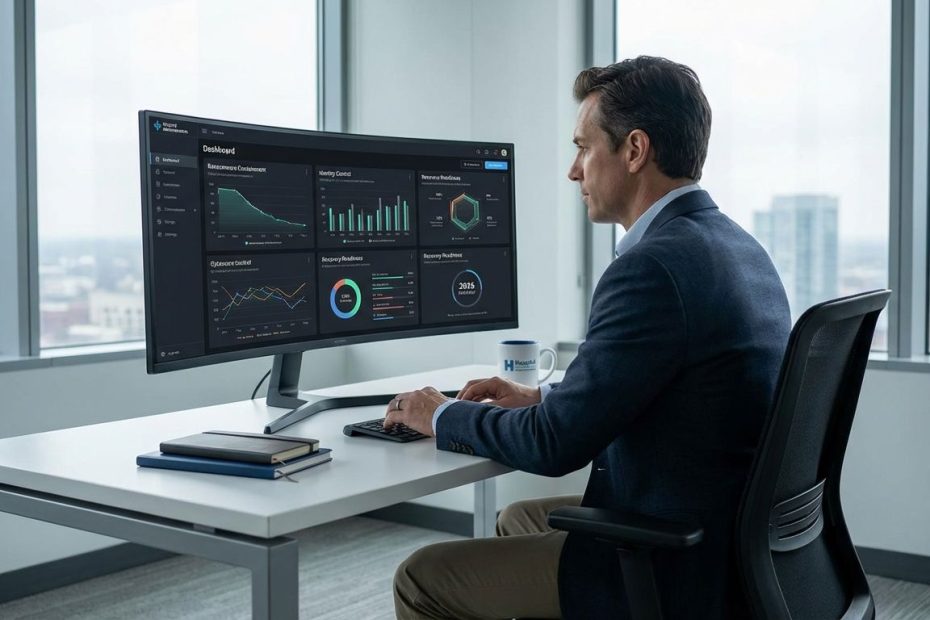
You do not win healthcare security in 2026 by buying “a tool.” You win by building a stack that makes ransomware containment, identity control, and recovery speed measurable, audit-ready, and repeatable across hospitals, clinics, and business associates.
This guide breaks down the nine cybersecurity tool categories healthcare CIOs rely on in 2026, what to demand in procurement, how to integrate them into security operations, and where these tools reduce real operational risk, downtime, and compliance exposure. Expect practical buying criteria, deployment notes that respect clinical workflow, and stack patterns that hold up under staffing constraints.
1. Managed Detection And Response With EDR Or XDR
If a healthcare environment still treats endpoint protection as “AV plus some alerts,” incident response stays reactive and expensive. In 2026, the default expectation is EDR or XDR telemetry plus a response-capable SOC motion, delivered in-house, co-managed, or as MDR. This category earns budget because it shortens the time between initial compromise and containment, which directly protects clinical uptime when ransomware operators start staging encryption.
Healthcare endpoints create messy realities: shared workstations, legacy OS in imaging, devices that are “owned” by vendors, and roaming clinician workflows. A strong EDR or XDR program standardizes collection and response actions across Windows, macOS, Linux, cloud workloads, and identity signals, then enforces containment actions that do not rely on someone noticing an email at 2 a.m. The practical CIO metric is simple: measured containment time, measured coverage, and measured isolation success without breaking care delivery.
Procurement works best when requirements are written in operational terms, not feature checklists. Demand endpoint visibility across managed and unmanaged assets, reliable isolation controls, investigation timelines that can be exported for legal and regulatory needs, and integration into SIEM workflows. When MDR is in scope, insist on documented escalation paths, defined response authority, and clear boundaries on what the provider will actually execute during a live ransomware event.
2. SIEM Plus SOAR For Unified Detection, Response, And Audit Evidence
Hospitals do not suffer from a lack of alerts, they suffer from scattered evidence. A modern SIEM collects and correlates signals across endpoint, identity, cloud, network, and key clinical platforms so the team can answer, “What happened, who did it, what moved, and what must be contained,” with timestamps that hold up in a post-incident review. In 2026, SIEM value is tied to data integration breadth, cost predictability, and response automation that a lean team can sustain.
SOAR matters because healthcare response needs repeatable playbooks for account takeover, privilege escalation, remote access anomalies, suspicious EHR access, and ransomware staging. The winning programs implement playbooks that start with containment and evidence preservation, then coordinate identity resets, token revocation, endpoint isolation, firewall actions, and communications triggers. That reduces improvisation and keeps response aligned with clinical operations and executive decision-making.
Vendor direction has moved toward “ecosystem ingest” and unified operations. Platforms are positioning themselves as able to ingest large numbers of third-party sources and correlate them with native telemetry to drive faster investigations and automated action. In a hospital, that matters because the log universe includes EHR audit trails, directory services, privileged access tools, VPN replacements, clinical identity layers, and third-party vendor access systems, not just classic network gear.
3. Identity And Access Management With SSO, MFA, And Identity Threat Detection
Identity remains the highest-leverage control in healthcare because it sits on top of everything: EHR access, clinical messaging, patient portals, SaaS billing tools, cloud infrastructure, and vendor remote support. In 2026, CIOs treat IAM as an availability control as much as a security control, because identity compromise is how attackers turn initial footholds into enterprise-wide outages. A modern IAM program couples SSO, MFA, lifecycle management, conditional access, and identity threat detection to cut off attackers early.
Operationally, healthcare teams need identity policies that work across varied user populations: clinicians, contractors, residents, traveling staff, revenue cycle teams, research, and third-party support. Strong IAM design enforces least privilege and reduces standing access, then adds risk-aware access decisions based on device posture and user behavior. When an incident hits, IAM becomes the control plane for rapid containment, session termination, password resets, and targeted access freezes that preserve patient care workflows.
Buying criteria should emphasize integration and response, not just authentication. Require clean integration into clinical identity tooling, tight hooks into SIEM correlation, granular reporting for audits, and support for modern phishing-resistant MFA where workflows allow. Also insist on a migration plan that reduces “MFA fatigue” tickets and aligns policy changes with clinical leadership, because adoption failures in IAM land on the CIO’s desk fast.
4. Clinical Shared-Workstation Identity And Fast User Switching
General-purpose IAM does not fully solve the shared workstation reality in patient care areas. Nurses, physicians, and allied health staff move constantly, devices are shared, and logouts are often skipped under time pressure. That creates audit gaps and expands the blast radius of compromised sessions. Healthcare-specific identity layers for shared workstations focus on tap-in, tap-out, fast user switching, session controls, and traceable user attribution without slowing clinicians down.
From an executive view, this tool category pays for itself when it reduces unsafe workarounds and improves traceability. You get cleaner user attribution for clinical actions, fewer shared credentials, faster re-authentication, and fewer open sessions left behind in patient-facing areas. During investigations, shared-workstation identity also improves forensic confidence because “who did what on which device” becomes defensible rather than guesswork.
Implementation decisions should be tied to clinical workflow mapping. Define which areas need tap-and-go, which need step-up authentication, and which need forced re-auth at high-risk actions. Pair deployment with a tight endpoint posture program and consistent timeouts, then route identity events into the SIEM so clinical identity signals correlate with endpoint detections and access events.
5. Zero Trust Network Access And Security Service Edge To Replace Or Reduce VPN Exposure
Healthcare environments have lived with VPN sprawl for years: remote staff, partner connectivity, vendor support, acquisitions, and distributed clinics. VPNs extend network trust in ways that attackers exploit, especially once credentials are stolen. In 2026, CIOs continue shifting toward ZTNA and SSE to move access decisions closer to applications and identity signals, reducing exposed attack surface and limiting lateral movement.
ZTNA and SSE are not just remote access replacements. They become a policy engine that ties identity, device posture, and risk scoring to application access, then enforces inspection and segmentation at scale. That matters in healthcare where third-party access is constant and difficult to police, and where the network contains a mix of modern cloud apps and legacy clinical systems. When ransomware operators gain a foothold, this category helps limit what a compromised identity can touch and how far an attacker can move.
Healthcare-specific value increases when zero trust controls integrate with shared workstation identity context and endpoint risk signals. Vendors have been explicit about combining device posture, identity context, and endpoint assessment to enable adaptive, risk-based access policies for medical institutions. When procurement is done well, the CIO gets consistent enforcement across users, shared devices, and cloud apps, with logging that supports compliance and incident response timelines.
6. Vulnerability And Exposure Management That Drives Patch And Remediation Outcomes
Scanning is not a program. Healthcare CIOs rely on vulnerability and exposure management tools that translate findings into remediation action that IT and clinical engineering can execute, with measurable progress and exception handling for systems that cannot be patched quickly. This category matters because known vulnerabilities remain a recurring entry path, and because ransomware crews routinely chain credential theft with unpatched systems to widen access.
Exposure management in a hospital must deal with medical device constraints, vendor support contracts, imaging systems, lab platforms, and downtime windows that are clinically controlled. The best programs align risk scoring with clinical criticality and actual exploitability, then build remediation lanes: rapid patch, compensating control, segmentation, or vendor-managed remediation. Reporting must satisfy executives, risk committees, and auditors without flooding operational teams with noise.
When selecting tools, evaluate asset discovery quality, authenticated scanning at scale, support for cloud assets and containers where relevant, and workflow integration into ticketing and change management. Also require the ability to demonstrate “time to remediate” by severity and business unit, since that metric is increasingly tied to governance and insurance scrutiny. The goal is fewer repeat findings, fewer exception requests, and fewer surprises during risk assessments.
7. Immutable Backup And Cyber Recovery Designed For Ransomware Restoration
Ransomware planning fails when backup is treated as a storage project. CIOs rely on immutable backup and cyber recovery tooling because it creates a realistic path to restore critical clinical services under attacker pressure. Detection tools reduce the odds of encryption, yet recovery tools reduce the consequence when detection is late or when attackers target backups directly. In healthcare, that consequence is measured in diverted ambulances, delayed procedures, and patient safety risk.
Cyber recovery requirements are operational: clean restore points, protected backup credentials, segmented backup infrastructure, immutability controls, rapid restoration for tier-0 apps, and frequent recovery testing. Mature teams pre-stage restore runbooks for EHR dependencies, identity services, and core network services, then test those runbooks under realistic time constraints. Recovery testing is where executive confidence is built, because it turns a theoretical plan into a measured capability.
Federal guidance aimed at the Healthcare and Public Health sector has repeatedly emphasized resilient backups, segmentation, MFA, and patching as key mitigations against ransomware-driven disruption. Treat that guidance as a procurement checklist: if backup tooling cannot be protected from the same identity compromise that hits the enterprise, it fails the only test that matters.
8. IoMT And Medical Device Security For Discovery, Risk, And Safe Segmentation
Medical device and IoMT security is no longer optional once the device estate is counted honestly. Many connected devices cannot run agents, cannot be patched quickly, and cannot tolerate aggressive scanning. Tooling in this category focuses on agentless discovery, behavioral profiling, risk scoring, and segmentation support so security control improves without breaking clinical operations.
A CIO-level program starts with inventory truth. It identifies what devices exist, where they are, what they talk to, and which communications are clinically required. From there, device security tooling supports policy enforcement through segmentation recommendations and anomaly detection that spots unusual traffic patterns, unexpected external connections, and lateral movement attempts inside clinical networks. It also improves incident response because teams can quickly answer whether an outbreak touched clinical devices and what is at risk.
Recent academic work continues to highlight multi-vector threats against connected healthcare devices and stresses the need for better threat modeling and forensic readiness in IoMT-heavy environments. That aligns with what security leaders see in practice: the device layer needs visibility and evidence collection that works even when traditional endpoint tooling cannot be installed. CIO procurement should prioritize integration into network controls and SIEM pipelines, plus workflows that clinical engineering can support.
9. Third-Party Risk Management And Security Ratings For Vendor-Heavy Care Delivery
Healthcare delivery depends on vendors: EHR hosting, billing, transcription, imaging, MSPs, device manufacturers, labs, and acquired clinics with inherited contracts. That creates persistent exposure through remote access, shared data flows, and business associate relationships. Third-party risk management tools help CIOs maintain repeatable vendor due diligence, continuous monitoring, and contract-aligned controls that go beyond annual questionnaires.
Strong programs separate “paper compliance” from operational controls. Vendor risk tooling supports evidence collection, tracks security requirements tied to contract language, and prioritizes follow-up based on vendor criticality and data access. Security ratings also help triage large vendor ecosystems, flaging trends that prompt verification or escalation when a vendor’s external security posture shifts in a concerning direction.
The biggest value comes from tying third-party findings into access design. Vendor remote access should route through identity controls and zero trust access policies, then log into the SIEM for correlation and investigation. When the organization can map vendor access paths to real controls and real logs, audits become easier and incident response becomes faster, especially in multi-entity health systems.
HIPAA Security Rule Pressure That Changes Tool Priorities In 2026
Healthcare security buying decisions increasingly align with controls that are specific, testable, and documented. Proposed updates to the HIPAA Security Rule have emphasized strengthening cybersecurity safeguards and reflect federal concern over the increase in large breaches tied to hacking and ransomware. That direction pushes organizations toward tighter risk analysis, clearer implementation expectations, and stronger evidence of ongoing security management.
For CIOs, this shifts procurement language toward audit-ready outcomes. SIEM retention becomes more than a technical preference, it becomes evidence preservation. IAM reporting becomes more than identity hygiene, it becomes proof of access governance. Recovery testing becomes more than best practice, it becomes a measurable operational safeguard with documentation that leadership can stand behind when downtime becomes a public event.
Tool selection also becomes harder to separate from operating model. Under tighter expectations, tools that cannot produce usable evidence, repeatable workflows, and measurable control performance become liabilities. The best healthcare CIO stacks are built around integration, operational simplicity, and measurable outcomes rather than isolated “best-of-breed” point tools that the team cannot staff.
How To Choose A Tool Stack That Your Team Can Actually Operate
Most healthcare security failures are not caused by missing tools, they are caused by stacks that cannot be operated consistently. Procurement should start with operating constraints: staffing, after-hours coverage, clinical downtime rules, and the reality of acquisitions and vendor access. Then pick platforms that reduce console sprawl, share telemetry, and enable response actions from a small number of control points.
Integration is the practical differentiator. Identity signals must correlate with endpoint behavior and network access decisions. Shared workstation identity needs to feed SIEM correlation. ZTNA posture checks need to consider endpoint risk scores. Backup tooling needs separate administration paths and strong authentication controls that do not live in the same blast radius as normal IT admin accounts.
Contracting should reflect the operating model you want. If MDR is part of the plan, response authority must be explicit, runbooks must be reviewed, and escalation must be tested. If internal operations own response, tooling must deliver clear investigation paths, low-friction automation, and reporting that executives can consume without translation. The end goal is fewer surprise gaps during incidents and fewer “heroics” required to keep hospitals running.
What Cybersecurity Tools Do Healthcare CIOs Rely On Most In 2026?
- EDR or XDR with MDR support
- SIEM plus SOAR
- IAM with SSO, MFA, ITDR
- Clinical shared-workstation identity
- ZTNA and SSE
- Vulnerability and exposure management
- Immutable backup and cyber recovery
- IoMT and medical device security
- Third-party risk management
Build The Stack, Then Prove It Works Under Pressure
You get durable results in 2026 by treating these nine categories as one operating system: identity as the control plane, endpoints as the early warning layer, SIEM and SOAR as the evidence and coordination engine, zero trust as the access governor, vulnerability management as the risk-reduction factory, and cyber recovery as the last line that keeps patient care available. The strongest programs set measurable targets for coverage, containment time, restore time, and remediation throughput, then report those metrics to governance on a fixed cadence. When tools integrate cleanly, security teams spend less time stitching data and more time reducing real risk. If the next budget cycle needs a north star, anchor it to operational outcomes: fewer preventable compromises, faster containment, and recovery that keeps clinics and hospitals open.
References
- HIPAA Security Rule NPRM | HHS.gov
- Ransomware Activity Targeting the Healthcare and Public Health Sector | CISA (AA20-302A)
- CrowdStrike Announces The Falcon Next-Gen SIEM ISV Ecosystem
- Zscaler Partners With Imprivata And CrowdStrike To Announce New Zero Trust Security Solution
- MDR/EDR SOC Options (Community Thread)
- Abusing The Internet Of Medical Things: Evaluating Threat Models And Forensic Readiness
- Rubrik: How Healthcare Organizations Drive Cyber Resiliency With Rubrik
- Healthcare Identity Management | Imprivata
- Identity And Access Management For Healthcare | Okta
- Zero Trust For Healthcare Cybersecurity | Zscaler

Maurizio Chiriva Internati (DBSc, PhDs) is a cancer immunologist and biotech entrepreneur with 20+ years in immuno-oncology. Co-founder and former CEO of Kiromic BioPharma (NASDAQ: KRBP), he has led AI-driven target discovery and translational programs, and has served on faculty at MD Anderson and Texas Tech.