
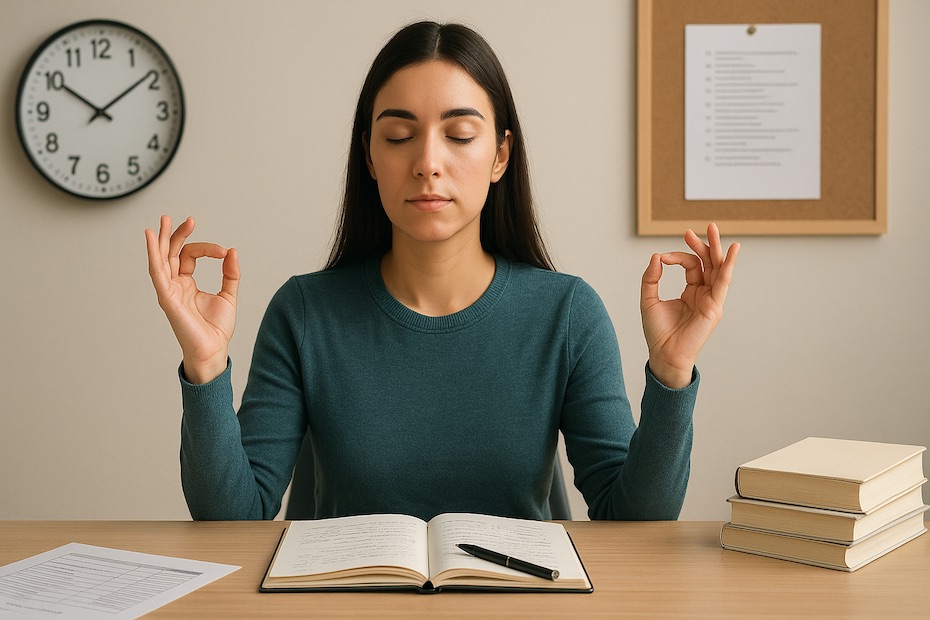
You can overcome test anxiety by mastering proven techniques that regulate your mental and physical responses to pressure. When you pair structured preparation with calm control and positive framing, you transform nervous energy into focus and confidence.
This guide shares five science-backed methods that professionals and educators consistently recommend to help you stay composed, prepared, and ready to perform at your best. Each technique empowers you to turn anxiety into action and maximize your exam results.
Technique 1: Establish a Realistic Study Schedule
The foundation of confidence is preparation. Test anxiety often stems from uncertainty, and a consistent study routine replaces that uncertainty with control. When you create a realistic schedule, you train both your body and mind to operate on a rhythm that reduces stress.
Instead of marathon sessions, break your study time into shorter, focused blocks. The Pomodoro Technique—25 minutes of work followed by a 5-minute break—has proven effective for improving retention and reducing fatigue. Rotate subjects every few sessions to keep your brain engaged and prevent overload.
A University of Colorado Boulder resource highlights that students who plan ahead and review regularly experience lower anxiety levels and better results. Consistency trains your mind to see exams as familiar challenges rather than threats.
Your schedule becomes a training blueprint. The steadier your routine, the calmer you’ll feel when it’s time to perform.
Technique 2: Practice Relaxation and Controlled Breathing
Anxiety triggers the body’s fight-or-flight response, which clouds judgment and memory. You can reverse that process by practicing relaxation and breathing techniques designed to reset your nervous system.
One proven method is box breathing—inhale for four seconds, hold for four, exhale for four, hold again for four. This slows your heart rate, increases oxygen flow, and tells your brain you’re safe. Progressive muscle relaxation, where you tense and release muscle groups from head to toe, also helps reduce tension.
Research from the University of Northern Colorado found that students who practiced deep breathing before exams performed better and reported feeling more in control. Integrate this into your daily routine for the best results.
Five minutes of intentional breathing before a study session or exam can make the difference between panic and precision. When your body is calm, your mind has space to think clearly.
Technique 3: Reframe Your Self-Talk and Mental Outlook
Your thoughts influence your physiology. When you say “I can’t do this,” your body reacts with stress; when you say “I’ve prepared for this,” your body relaxes and your focus sharpens.
Harvard’s Academic Resource Center emphasizes that positive self-talk enhances confidence and reduces anxiety during exams. The key is repetition—training your internal dialogue to replace fear with facts. Tell yourself what’s true: you’ve studied, you’ve practiced, and you’re ready to execute.
Develop a short list of affirmations to use during study sessions and before the test:
- “I know this material.”
- “I’ve done the work.”
- “I’m focused and capable.”
Pair affirmations with visualization—see yourself calmly writing, recalling answers, and finishing strong. These exercises create neural pathways that reinforce confidence and preparation, not panic.
Technique 4: Simulate Real Exam Conditions
You can’t fully remove anxiety, but you can desensitize yourself to it. Practicing under exam-like conditions trains your brain to function smoothly when pressure hits.
Set up mock exams at the same time of day as your actual test. Eliminate all aids, time yourself strictly, and replicate the seating environment as closely as possible. Research published on ResearchGate in 2023 shows that simulated testing reduces stress and improves performance by up to 80%.
Students who test themselves weekly before finals report greater calm and fewer last-minute jitters. This method transforms unfamiliar situations into routine challenges.
The more you expose yourself to exam conditions, the less novelty remains. Familiarity eliminates fear.
Technique 5: Optimize Physical Wellness for Mental Performance
Mental focus depends on physical balance. Lack of sleep, poor nutrition, or dehydration intensify anxiety and impair concentration. Treat your body as your exam engine—if it’s under-fueled or over-stressed, performance suffers.
Research from the Virginia Association of Nurse Anesthetists found that maintaining hydration, balanced nutrition, and regular exercise significantly reduces test anxiety. Sleep, in particular, is critical: students who sleep 7–9 hours nightly show stronger memory retention and better cognitive control.
These adjustments don’t require radical change, but they yield measurable results. A healthy body is the foundation of a steady, high-performing mind.
Best methods to overcome test anxiety
- Build a consistent study plan
- Use breathing techniques
- Reframe negative self-talk
- Simulate exam pressure
- Maintain physical wellness
Perform with Confidence
Test anxiety is not a measure of your intelligence—it’s a signal that you care about performing well. The techniques you’ve learned here give you the tools to redirect that energy into focus and execution. When you control your preparation, your body, and your thoughts, you control your outcome.

Maurizio Chiriva Internati (DBSc, PhDs) is a cancer immunologist and biotech entrepreneur with 20+ years in immuno-oncology. Co-founder and former CEO of Kiromic BioPharma (NASDAQ: KRBP), he has led AI-driven target discovery and translational programs, and has served on faculty at MD Anderson and Texas Tech.