
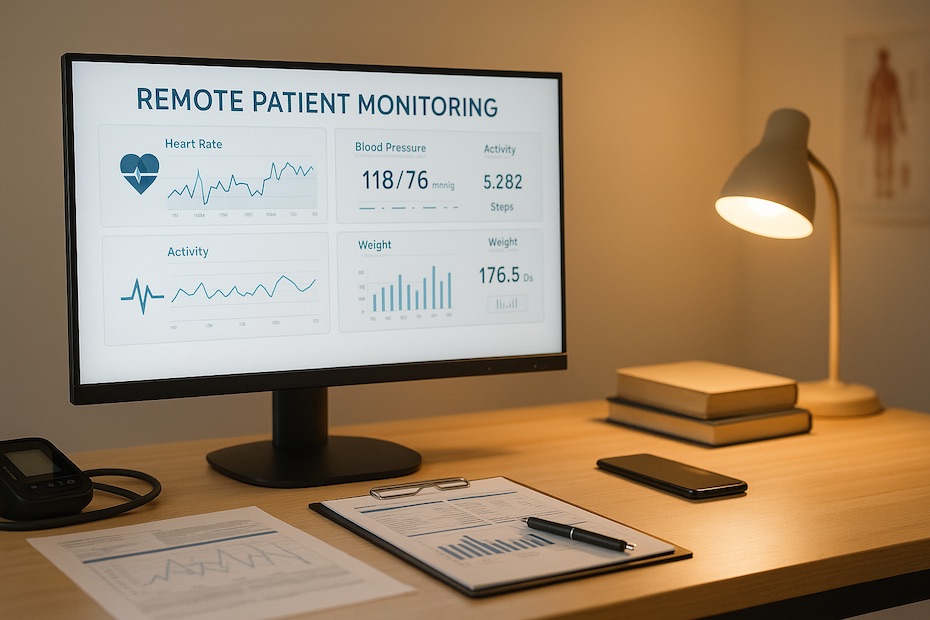
You advance value-based care by using remote monitoring and patient engagement platforms that strengthen prevention, reduce avoidable utilization, and keep patients connected beyond clinic walls. These platforms give you continuous data, actionable insights, and reliable patient communication — all essential for cost-efficient, high-quality outcomes.
This article evaluates 10 leading platform types in remote patient monitoring (RPM) and engagement, giving you a detailed view of their capabilities, real-world use cases, and strategic advantages in value-based care environments. You’ll learn what each model offers, how they support chronic-care management, and how you can apply them to strengthen outcomes and operational performance.
1. Health Recovery Solutions (HRS): Full-Service RPM for Chronic Care
HRS remains one of the strongest RPM solutions for organizations that want an end-to-end model. You get device logistics, onboarding, monitoring dashboards, vitals aggregation, alerts, care-team messaging, and patient education tools in a single environment.
As a value-based care leader, you benefit from their structured workflows that reduce readmissions and support consistent chronic-disease monitoring. Their integration options also help teams fold RPM insights into broader care-coordination models without heavy customization.
When you deploy HRS, you accelerate patient adherence, improve visibility into high-risk cases, and reduce gaps in care. Their data flows help you intervene earlier and prevent costly complications.
2. OceanMD: Patient Engagement and Data Exchange at Scale
OceanMD’s platform strengthens value-based care through digital check-ins, secure messaging, eReferrals, and patient-facing tools that streamline communication. Because it integrates with a wide range of EMRs, you reduce administrative burden and prevent fragmented data.
You benefit from OceanMD when your value-based care strategy depends on coordinated workflows. The platform supports patient self-serve forms, risk-screening pathways, triage workflows, and communication channels that keep your team connected to patients between visits.
For large or multi-clinic networks, OceanMD’s interoperability gives you stability, auditability, and continuity across different clinical systems.
3. HealthSnap: AI-Driven RPM With Predictive Analytics
HealthSnap offers predictive analytics, longitudinal vitals tracking, and AI-enabled risk identification. With rising chronic-disease prevalence and increasing pressure to reduce preventable utilization, this platform gives you a future-oriented set of capabilities.
You gain early warnings for deterioration, better population segmentation, and automated workflows that reduce staff load. HealthSnap is especially valuable when you manage large chronic-care populations requiring continuous monitoring and trend-based interventions.
Its tools also help you optimize care-management resources by directing attention toward patients most likely to destabilize — a major advantage in value-based contracts tied to outcomes and utilization metrics.
4. Device-Integrated RPM Suites: A Flexible Model for Multi-Condition Monitoring
Many organizations prefer a flexible bundle that pairs FDA-cleared devices with an EHR-linked RPM software layer. This gives you control over which devices to deploy, how to configure monitoring protocols, and which conditions to prioritize.
This model works well for hypertension, diabetes, heart failure, COPD, and obesity programs. You get steady data streams — blood pressure, glucose, pulse oximetry, weight, heart rate — without committing to a locked-down environment.
When you operate in a value-based care program requiring tailored disease management, this modular model lets you optimize device selection, training, and turnaround. It also gives your care teams clearer oversight without adopting a fully outsourced model.
5. RemotePatientPro-Style Enterprise RPM Platforms: Scalable Monitoring for Large Populations
Enterprise-level RPM platforms use dashboards, alerts, and care-team workflows designed for high-volume environments. You gain scalability for thousands of patients, automated flags for out-of-range readings, and structured outreach pathways for consistent follow-up.
If you run risk-bearing contracts, enterprise RPM platforms provide the infrastructure to monitor chronic-care patients at population scale. You also improve accuracy and consistency in triage, preventing both unnecessary interventions and avoidable escalation.
These platforms support various chronic conditions and behavioral-health needs — making them effective tools for organizations with broad patient demographics.
6. Hybrid RPM + CCM Platforms: Integrating Monitoring With Coordinated Care
Hybrid platforms combine remote monitoring with chronic-care management (CCM), creating continuity across coaching, education, medication adherence, lifestyle support, and vitals collection.
This model works when you want a unified environment that addresses both clinical and behavioral components of chronic-care success. You support patients through regular check-ins, structured care plans, and guided self-management alongside remote vitals.
In value-based care environments, hybrid RPM + CCM reduces fragmentation and improves adherence. You strengthen your preventive strategy by integrating engagement and monitoring into a unified care experience.
7. Telehomecare and Telehealth-Integrated Monitoring Platforms
Telehomecare platforms merge telehealth visits, messaging, vitals collection, and coaching into a single workflow. You give patients remote access to consultations while continuously capturing key health metrics.
For patients with mobility challenges, distance barriers, or complex chronic conditions, telehomecare platforms create a reliable at-home care model. Vitals flow directly to your staff, and telehealth sessions provide timely intervention opportunities.
By combining virtual visits with RPM, these platforms support long-term stabilizations, reduce unnecessary ED visits, and maintain consistent communication — aligned with value-based care incentives.
8. Wearable-Integrated Platforms for Real-Time and Continuous Monitoring
Wearable-enabled platforms let you track physiological signals beyond spot-check vitals. Continuous heart rate, activity levels, sleep data, and oxygen saturation reveal patterns that traditional devices miss.
You gain visibility into early trends related to cardiac decline, respiratory issues, or metabolic shifts. Wearables also increase patient adherence because they require minimal effort and integrate naturally into daily life.
In value-based models, continuous data supports early detection and proactive management — two of the highest-leverage moves for cost control and quality improvement.
9. Patient-Engagement Platforms With RPM Support
Engagement-first platforms focus on patient communication, reminders, educational content, and self-reporting. When these tools integrate RPM data, you create a cohesive experience where patients feel connected, informed, and supported.
You strengthen adherence through automated reminders, structured messaging, appointment coordination, and digital touchpoints that reduce friction in the care journey. Patients remain active participants instead of passive recipients.
These platforms are ideal for organizations emphasizing behavioral-health integration, care navigation, and lifestyle-modification programs.
10. Customizable RPM Suites Built by Health Systems or Vendor Partners
Some organizations build or commission their own RPM and engagement suites. These custom solutions integrate device data, telehealth, predictive analytics, multilingual support, and care-management modules.
This route works well for large systems with diverse populations and multiple service lines. You gain flexibility to tailor every aspect of your RPM program — clinical rules, triggers, dashboards, protocols, and engagement workflows.
When you manage extensive populations or operate across different regions, custom suites provide unmatched adaptability, allowing you to configure the platform to your value-based care contracts.
What benefits do these platforms unlock for value-based care?
Remote monitoring and engagement platforms generate consistent value in cost-controlled, outcome-driven environments:
You reduce readmissions through early detection. When vitals and symptom data reveal destabilization, your team intervenes early to prevent escalation. That stability reduces inpatient utilization and helps your organization outperform benchmarks.
You improve chronic-care outcomes. Reliable monitoring supports long-term improvement in diabetes, hypertension, COPD, and heart failure — major cost drivers in value-based contracts.
You strengthen patient satisfaction and involvement. Engagement tools empower patients with clarity, reminders, feedback, and consistent communication. Engaged patients follow treatment plans more reliably and show stronger long-term outcomes.
You streamline clinical operations. Automated data capture, alerts, outreach pathways, and patient-reported inputs reduce administrative burden and support continuous oversight without increasing staff workload.
You build scalable infrastructure for future expansion. Once an RPM-engagement stack is in place, you extend it to new disease groups, new populations, and new care models with minimal disruption.
How should you evaluate and choose the right platform?
Choosing a platform requires clarity on three core areas: goals, population, and integration.
Start by defining your care objectives. Determine whether you aim to reduce hospitalizations, enhance chronic-care adherence, expand telehealth, improve post-discharge stabilization, or manage high-risk patients. Each platform type fits different priorities.
Assess patient access and digital familiarity. Some populations need device simplicity; others benefit from wearables or app-based engagement. Matching patient capabilities with platform features increases adoption and reduces dropout.
Evaluate integration. A platform that connects to your EHR, accommodates your care workflows, and supports your reporting requirements will produce far better outcomes than a standalone system.
Plan for operational scaling. Ask vendors about support, onboarding, training, analytics, and device logistics. A platform must grow with you — value-based contracts require long-term reliability and adaptability.
Best Platforms for Remote Monitoring & Engagement
- HRS for chronic-care RPM
- OceanMD for engagement and EMR integration
- HealthSnap for AI-powered RPM
- Wearable-enabled RPM for continuous monitoring
- Telehomecare platforms for virtual care continuity
Strengthen Your Care Model With Technology That Drives Results
Remote monitoring and patient engagement platforms form the backbone of modern value-based care. When you deploy the right tools, you gain real-time insight, strengthen preventive care, reduce emergency utilization, and keep patients involved in their own outcomes. These 10 platform types give you a strategic foundation for building scalable, measurable, and patient-centered care programs that support both quality and cost goals. Choose with intention, implement with precision, and you position your organization to deliver higher performance across all value-based contracts.

Maurizio Chiriva Internati (DBSc, PhDs) is a cancer immunologist and biotech entrepreneur with 20+ years in immuno-oncology. Co-founder and former CEO of Kiromic BioPharma (NASDAQ: KRBP), he has led AI-driven target discovery and translational programs, and has served on faculty at MD Anderson and Texas Tech.